Archive · 8 August 2012
Moving to the Oracle APEX Listener
Written 14 years ago. Oracle APEX has moved on a lot since; check the current Oracle APEX posts too.
Are you already using the Oracle APEX Listener in front of Oracle Application Express (APEX) or are you still using Apache with mod_plsql as your webserver (or the EPG)?
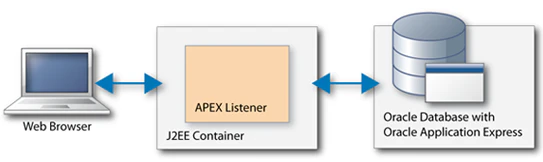
This year I started to give a presentation why I believe you should move to the APEX Listener.
If you missed my presentation at OGh, ODTUG or UYOUG, I’ll give this presentation again in Brazil and Santiago as part of the LA OTN Tour, at Oracle Open World (OOW) and at the UKOUG.
In the presentation I go briefly over the pros and cons of Apache with mod_plsql, the Embedded PL/SQL Gateway (EPG), but spend most of the time on the APEX Listener (hence the title).
After OOW I’ll publish a whitepaper about this topic as well, so you can read it in full detail and have some test cases you can try in your environment.
Nevertheless I already wanted to blog about some points of my presentation and whitepaper, especially in the light of APEX 4.2 and the upcoming 2.0 version of the APEX Listener.
Background; before I wanted to move off Apache with mod_plsql (to the APEX Listener) there were two important parts I wanted to be sure of:
- is the APEX Listener as reliable and performant as Apache with mod_plsql and
- do I get at least the same features (or more) with the APEX Listener compared to the others
For the first point I can say we successfully run the APEX Listener now for 1,5 year in different environments. To name two; one environment is using Glassfish and the APEX Listener on top of Oracle Linux on the hardware of a customer and another one is running on our own server at Amazon, Oracle Linux and Glassfish with the APEX Listener with an Apache reverse proxy in front of it.
 |
| JMeter configuration |
Performance wise I show in my presentation and whitepaper how you can test your own configuration with JMeter, so you have real metrics. Depending the test case I ran on my system, I got different results, but in general the APEX Listener was as fast or faster than Apache with mod_plsql.
Again you don’t need to take my worth for granted, but test it out yourself in your environment by simulating your load with JMeter. How to do that you can read in my whitepaper or in this excellent post of Chris Muir (note that in APEX 4.1.1 you need to add some extra parameters to get it to work which are not described in the blog post).
On the second point; the features of the APEX Listener compared to the other choices, I can be short.
The APEX Listener will give you more features… even more interesting… if you are not using the APEX Listener from APEX 4.2 onwards, some functionalities for ex. RESTful Services won’t work for you.
 |
| RESTful Services |
At the moment APEX Listener 1.1.4 is the production version, but a few days ago APEX Listener 2.0 (EA) was released. You can read more about this release on Kris’ blog. In my next post I will also highlight the biggest differences between APEX Listener 1.x and 2.x.
Hopefully by this post I hope to trigger you to look at the APEX Listener a bit closer in the next weeks and months if you are not using it yet…
Originally published on Blogspot.
Comments
No comments yet. Be the first.