Archive · 4 May 2009
Collaborate 09 - Monday
Written 17 years ago. Oracle APEX has moved on a lot since; check the current Oracle APEX posts too.
As usual I woke up at 4 am, but I’m still doing good.
Today I started slow… I didn’t follow any sessions before noon.
My first session of the day was “Running Oracle in the Amazon EC2 Cloud” by Tony Jedlinski.
Tony described how he created his Oracle Enterprise Linux instance with Oracle Database XE on Amazon EC2. His presentation was based on the white paper of Justin Lokitz, but Tony extended it with the new Amazon UI. I liked the presentation as he brought the message at a nice peace and I think most of the people knew how to get started now.
We (site no longer online) have been playing with Oracle and APEX on Amazon too and so far everything went well. We are not to far off to actually use it for production hosting. Another tip I can say is that next to the UI Amazon provides there is also a nice plugin for Firefox called Elasticfox.
The next session I attended was “Oracle Application Express 3.2 Forms Conversion” by David Peake. I’ve seen that presentation many times now, but I always find it interesting to see how the public reacts to the presentation, which questions they have etc.
David gave a quick intro into APEX as some people where completely new to it and then started to talk about the conversion tool. He also demoed it of course!
I really looked forward to my last session of the day: “An Architectural Review of Application Express” by Dr. Paul Dorsey. I have a lot of respect for Paul, he’s a very knowledgeable guy in different areas especially PL/SQL, Forms and JDeveloper. So I wondered what he thought about APEX. Paul is also an advocate of thick databases and he developed a product called BRIM to support that idea. APEX is living in the database, so that is inline with his view of thick databases. Yesterday I was sitting next to him at dinner and we had a nice talk about a project he’s currently doing in Ethiopia. There he has the challenge of delivering applications with very limited bandwidth. His BRIM product is much lighter (transferring data) than any other development tool, including APEX, so I knew a bit more about his background.
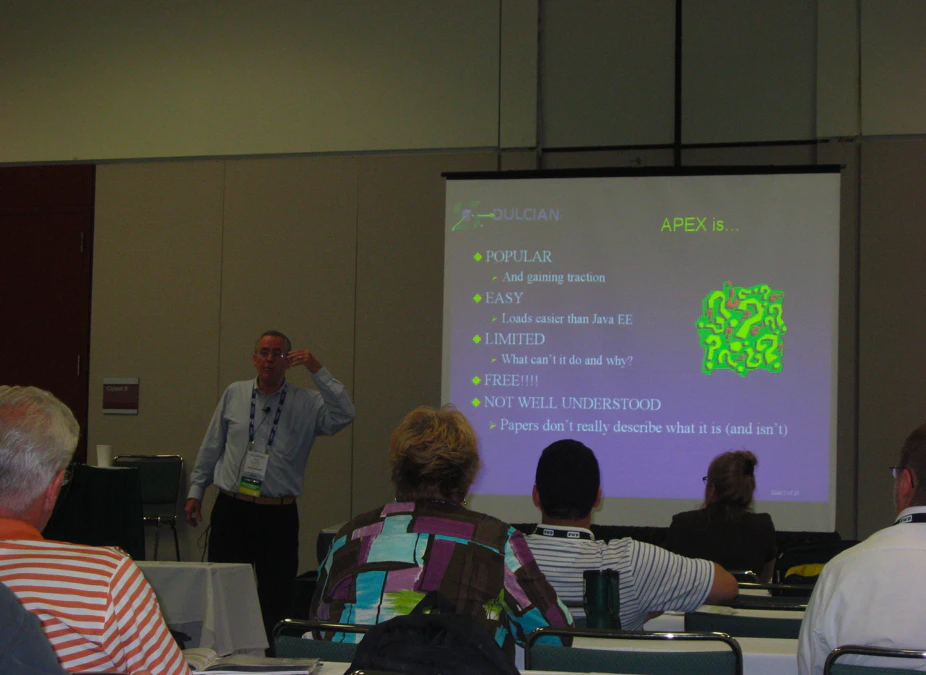
I did enjoy the talk and he raised some very interesting points, but on some things I have a different view on. My impression was he reviewed APEX as is for ex. he said that an APEX page can only be linked to one table, which is not completely true. If you base the standard process on a view and you use instead of triggers as I described here, you can support multiple tables. So Paul looked at everything APEX allows you to do with the wizards and how APEX is behaving out of the box, but nothing more. So in that respect I can understand what he was saying. But I see different levels of people using APEX:
- Level 1: You just use the wizard in APEX and are able to be productive with it
- Level 2: You know also the Oracle database including SQL and PL/SQL and include that knowledge into you APEX applications (APEX is living inside the database so you can use all the database features)
- Level 3: You know also more about web development like javascript and css and use that in your APEX applications
- Level 4: You know also web 2.0 and use AJAX, jquery, json and other plugins to get exactly what you want
Paul talked about staying in the APEX sandbox (level 1) and don’t try to do other things with it. Of course it’s true that you need to have (other) knowledge to achieve what the wizard is not doing for you, but I don’t agree you should stay in the sandbox. APEX has some nice API’s you can use, so why not doing it? If you first look at APEX you might not know about them, I agree with that, but if you follow training and/or you ask more experienced APEX people to coach you, it doesn’t take that long to know how to achieve other things.
Although Paul was sometimes very critical on APEX, he didn’t flame it. He even said he liked APEX and it’s a great tool in some cases, but does not full-fill in others, which I can agree with. You need to use the tool that fits within the projects. And he made a very nice quote at the end of his presentation: “APEX is frequently used to prototype or “get something out the door quickly” until the “real” application is built using some enterprise-level took architecture. APEX systems are typically completed in a few months and two years later, people are still waiting for the “real” application to work.”
Paul is doing this presentation again at ODTUG this year, so I’m interested to know other people’s reactions.
After the presentation I went to the Exhibition hall and the party to get some drinks, food and had talks with some nice people like Sue Harper, OracleNerd (Ched) and his wife, David Peake, Tony Jedlinski, Jeremy Sneyder and many others…
Originally published on Blogspot.
Comments
No comments yet. Be the first.